Due to some technical difficulties, I was unable to post this while I was actually in Mexico in January. Here is a compilation of updates I attempted to post from our first stop on the two-week adventure, Puebla:
Like all my travles, Mexico has been an adventure. But I wouldn't want it any other way. The town we are staying in is beautiful and reminds me almost exactly of Leon in Nicaragua. It's significantly nicer than I had anticipated with all the negative stories pumped out about Mexico...I wouldn't want to spend quality time near the border where things ARE dangerous, but Mexico has so much more to offer than what we read in the news. We have been taking day trips to nearby towns, and it's been really interesting to be able to see this in perspective. Cholula was a fun trip, we got to visit a church that the Spanish built on top of a gigantic indigenous pyramid to show their domination. The hike up was pleasantly steep, but there was a great view from the top (now to find pictures...) The people have all been amazing too, very friendly, very welcoming, very helpful, and the Spanish is super clear, which makes it easy to jump right in.
On one of our day trips, things got interesting when our bus broke down in the middle of nowhere on a dirt road about 4 hours from town in an area with no cell reception. Fast forward 2 1/2 hours, and it was pitch-black outside when we finally caught a public bus to the nearest town where we ran to the bus station (while shoving delicious street tacos in my face, yummm!) to catch a bus back to Puebla and *finally* a cab back to the hotel. We got back 7 hours later than planned, but it made for an entertianing evening. All things good so far! :)
I also got to interview the secretary for the state of Puebla's Oportunidades program, which is the CCT program that Argentina's Asignacion Universal por Hijo (the program I will be studying for my thesis) is based on. This was a "friend of a friend of a friendx5" kind of connection, so I was pretty sure I wasn't actually going to meet with her, but everything worked out, and we had an amazing 2 hour conversation about the program, what works, what doesn't, etc. It was SO helpful to be able to talk to someone that involved in the policy process that she could answer all my questions! The interview became the meat of my Mexico final paper and should turn out to be useful in my thesis down the road!
Following this high, I got really unbelievably sick. Something I ate, I'm sure, but how am I going to go on a food studies trip and be surrounded by amazing Mexican street food and NOT try things? Anyway, after 3 days of not being able to stand up straight and sleeping 14 hours a night (the other 10 hours of each day consisting of either time in the bathroom, figuring out where the nearest bathroom was, or how much longer I could last before I *needed* a bathroom), it was time to call in a professional. My Mexican doctor experience was less traumatic than my Chilean doctor experience -- perhaps the Chilean doctor did me a favor by taking the time to teach me to pronounce "dia-rrrrrrrrray-uh" correctly -- and after my first round of antibiotics and a bottle of pedialite, I was back on the move, just in time for our 5-hour bus ride to Oaxaca!
Friday, March 2, 2012


Saturday, October 29, 2011
Fall Happenings in Soho -

Here are a few shots from Fuerza Bruta - a show no pictures (or second-hand explanation) can do justice.


Mud Run in the Bronx

A movie theater nearby. Expensive, but cool - the theaters are all in the underground level.
Did I Just See That? (2)
Midterms and other random hecticness associated with City life have kept me from being as regular as I had hoped with this. Here are a few of the many unbelievable things I've seen recently -
- I witnessed the "Beat a Bubble-wrapped Boy with a Bat for a Buck" fundraiser "in full swing". An organization was holding this event in a campus building...I'm not sure how long it lasted before it was shut down
- A student being handcuffed up against the library wall
- A man walking down my street with a cat on his head
- A 4-car cop chase that led to the cop cars FLYING through a busy intersection (causing several near accidents), so finally the driver of one of the cop cars grabbed his megaphone and yells "GET OUT OF THE WAY." That's right, NYC police mean business.
- And a shrine outside the Apple store when Steve died - I thought the apples on the ground were an especially nice touch :)

Tuesday, September 27, 2011
Did I just see that? #1
I was asked to name the weirdest thing I've seen in New York so far, and I was torn...
- There was the guy riding his bike with no handle bars carrying a big screen TV overhead. Seriously, how are you going to get yourself out of that position?
- There's the bike that was locked to a stop sign with a big Kermit the frog sitting on the seat (note: I saw Kermit sitting on a fire hydrant later that night).
- It could be the man I saw in Trader Joe's today who literally had every inch of skin tattooed some shade of blue or green. Not kidding, even his nose.
Because I see some pretty odd things on a pretty regular basis, I'm going to start posting regularly about some of the strange things I see on the streets of New York City. Please comment on favorites :)

Thursday, September 1, 2011
RIO
 |
| Looking out over a favela in Rio |

Our hotel was a block in from Copacabana beach, and we were just a couple miles down from Ipanema. Outside of class meetings, we had plenty of time to explore markets, hang out at the beach, and see the iconic touristy sights
 |
| We didn't do such a good job of abiding by the "do not feed the animals" sign |
and we took the cable car up to Sugarloaf Mountain.
 |
| Sugarloaf |
 Sunday, we went to Ipanema, just like the rest of the town. It was amazing to see how EVERYONE was at the beach. People were playing volleyball and futevolley (a combination of soccer and volleyball), running, biking, flying kites, laying on the beach, selling food, drinks, and hats....the beach is where life happens and people make friends in Rio. It was a nice way to end our trip and relax for a bit before dodging the hurricane and making it back to NYC!
SALVADOR
Amazing. Salvador is much more what I was expecting out of Brazil -- very cultural, great food, lots of beach! Our hotel is on top of a huge hill that overlooks the city and the ocean. We have been doing more university visits here. It feels like a very fast stop!
There is a much bigger African population here than in SP (80%!), and we had the chance to see a performance that combined traditional African dance, condomble (African religious ceremony), and capoiera (martial arts meets dance -- slaves used this to train to fight in an undercover way!)
...This was after an amazing group dinner of moqueca, a traditional Bahian dish...fish in a tomato and coconut milk-based sauce, served with grilled peppers and onions, over rice.

We had a free weekend, so Saturday we went to the historic center to go to the huge Mercado Modelo, a market with all kinds of leather sandals, tshirts, artwork, jewelry, and on and on and on...
Sunday was beautiful. So outside of a long run through town and a quick food break, most of us spent the whole day soaking up the sun from our rooftop pool.

One thing I've really enjoyed here is the language. My Portuguese is pretty limited, but I know enough to get by for the few days we're in Brazil. The only people here that speak any English are the hotel staff and the professors we meet with at universities...people have been really patient though, I think they mostly appreciate the effort of foreigners to speak their language (and to realize that it is NOT Spanish). The exposure has made me really excited to learn more when I get back...I'm thinking a Port. class this fall is a must!! Monday night,w e fly to Rio de Janeiro for our final days in Brazil...
Ate mais!
SAO PAULO
Sao Paulo felt like a strange combination of NYC meets South America. It was very obvious that it is the big business and financial center of the country. Our hotel was located just off of the big, trendy shopping district. It was good to see this side of South America, because most of my Latin American experiences have been in poor, rural areas.
We had several site visits for class, meeting with universities and public and private high schools. The course is about race and higher education in Brazil. Brazil imported over 10 times the number of African slaves that the US did, so 50% of the population is of African descent. There is also HUGE income inequality in Brazil, and blacks are disproportionately affected. Much of this problem relates to the structure of the education system.
Public high schools are free, but the education is of very low quality, and the schools have very limited resources. Those families who are well-off pay huge amounts of money to send children to private high schools. These are usually white students. Attending a private high school and getting a good education leads these students to landing spots in *free,* highly-respected public universities.
There is much competition for admission to Brazil's state and federal universities. Admission is based on an exam called a vestibular, created by each department within each university. Public high school students are not well-prepared to perform on the exam, and since they come from poor families, they are unlikely to be able to afford test prep or tuition at a private university.
At the public high school we visited, only 20% of the students go on to college, whereas the private school we visited sent 98-100% of students to college. To attack the problem, the government has toyed with affirmative action and quota policies to increase the number of public HS students or the number of black students in universities. It's difficult to determine whether this is a problem based on race or socio-economic status. There's also much debate over the "fairness" of implementing steep quotas...Should the government stop or reduce funding a the university level to enhance public education at the high school level?
We have been studying the system, the outcomes of affirmative action and quota policies, and meeting with activist groups that help with exam prep, black representation, etc.
Outside of class visits, SP was a huge city to explore...lots of antique, craft, food, and jewelry markets, museums and parks, but my favorite part was visiting a neighborhood outside the city center.
Some of us ventured out to find an extended alley that was transformed into an amazing work of art. The government was basically getting fed up with graffiti and vandalism, so they decided to pay artists to decorate (graffiti) the walls of this street.
It was beautiful, the paintings were all so colorful and so different from one another. It was very off the beaten path, not mentioned in tourist books, so it was nice to see the residential side of SP. That was more "real Brazil" to me than being in the hustle-bustle of the ritzy shopping district downtown. The graffiti is redone every 4 months or so, so it is kind of cool to think about how unique my experience was from what anyone else has seen or will see in the future. Next up: Salvador!
 |
| At the Japanese district in Sao Paulo - The second largest Japanese population in the world lives here! |
Public high schools are free, but the education is of very low quality, and the schools have very limited resources. Those families who are well-off pay huge amounts of money to send children to private high schools. These are usually white students. Attending a private high school and getting a good education leads these students to landing spots in *free,* highly-respected public universities.
There is much competition for admission to Brazil's state and federal universities. Admission is based on an exam called a vestibular, created by each department within each university. Public high school students are not well-prepared to perform on the exam, and since they come from poor families, they are unlikely to be able to afford test prep or tuition at a private university.
At the public high school we visited, only 20% of the students go on to college, whereas the private school we visited sent 98-100% of students to college. To attack the problem, the government has toyed with affirmative action and quota policies to increase the number of public HS students or the number of black students in universities. It's difficult to determine whether this is a problem based on race or socio-economic status. There's also much debate over the "fairness" of implementing steep quotas...Should the government stop or reduce funding a the university level to enhance public education at the high school level?
We have been studying the system, the outcomes of affirmative action and quota policies, and meeting with activist groups that help with exam prep, black representation, etc.
Outside of class visits, SP was a huge city to explore...lots of antique, craft, food, and jewelry markets, museums and parks, but my favorite part was visiting a neighborhood outside the city center.
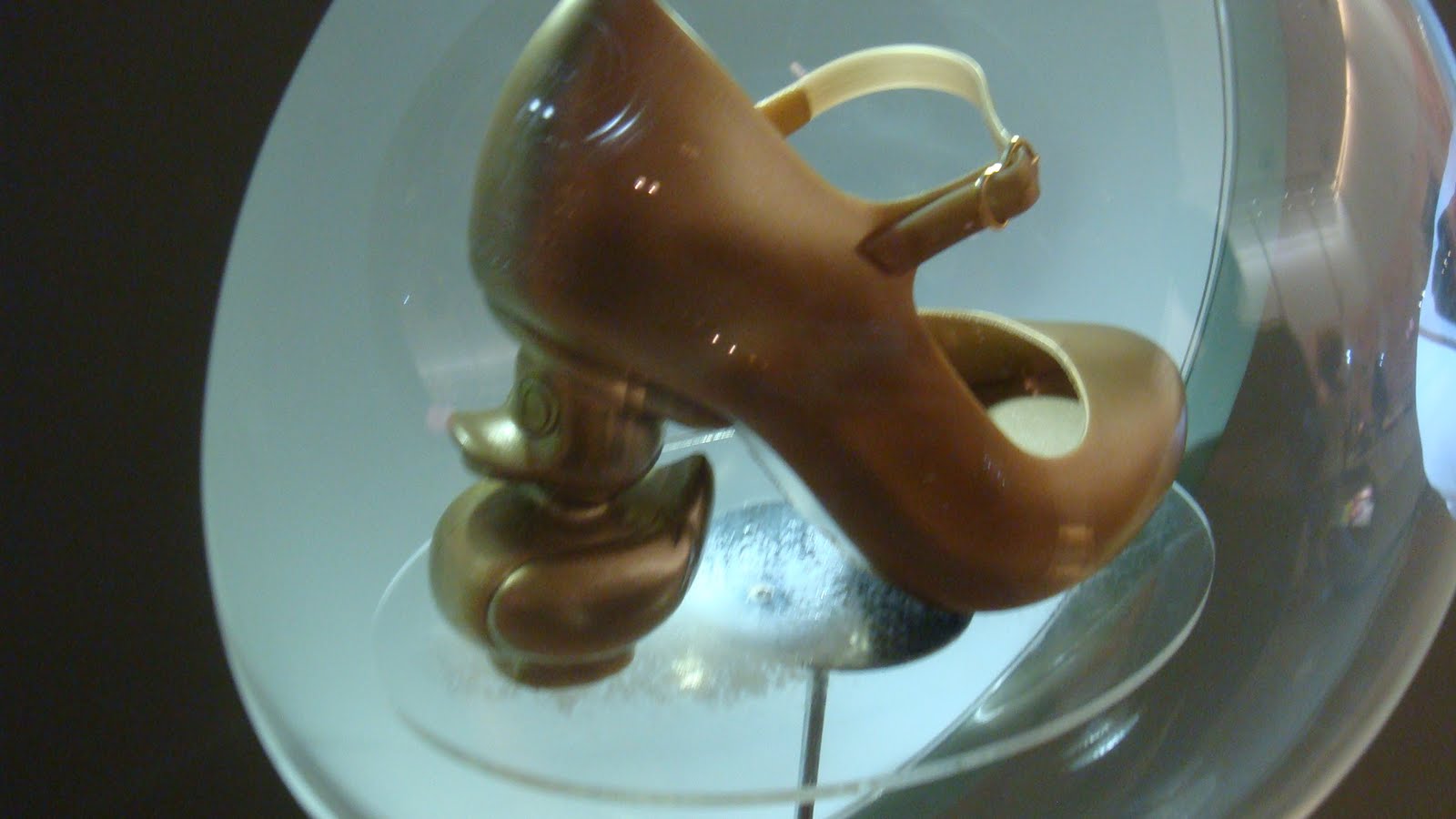 |
| Rubber Ducky High Heels from the Melissa Store.... |
 |
| Boca de Batman --- Graffiti |
Subscribe to:
Posts (Atom)